New semester and new job on the horizon!

As my first semester at PPCC draws to a close, I am taking stock of all I’ve learned but also looking forward to the new challenges January will bring. My courses for the new semester are Contracts, Property Law, Civil Litigation, and Estates and Probate. January is, of course, also the start of tax season (Feel free to ask me for tips! I AM authorized to practice taxes!) and thus a new phase of employment. This year I’ve been asked to be an office manager, so I am very much looking forward to whatever additional light my coursework can shed on the workings of tax law. Any knowledge I gain from it is knowledge I can also pass on to everyone else at my office, after all!

To all who read this, I wish you a happy holiday season and a bountiful new year!

Weekly Time and Billing Reports

Every paralegal program class at PPCC has Time and Billing Reports as weekly assignments, one of the best practical career-prep elements of the program. In order to prepare for the necessity of tracking billable hours at a law firm, every week we record the tasks we do for each class, when the work occurred, how long it took, and what that time would cost at the current market rate for paralegal services. T&B reports are due every week at the same time, no matter how much or how little assigned work there was for the class that week. I found it to be very helpful in developing the skill of tracking my start and end times and noting when I switched from one task to another, since I am by nature something of a multitasker (my Internet browsers invariably have at least 3 tabs open at any one time). Below is a page from my Torts Time and Billing Report.

2012-12-16_0258

My 2 cents on tort reform

The final paper for my Torts course, summarizing the history of tort reform in Colorado and taking a position on what kinds of reform are most appropriate. I chose to focus on medical malpractice torts, as the rapid growth in health care costs as a percentage of GDP and the recent passage of the Patient Protection and Affordable Care Act (a.k.a. health care reform, a.k.a. Obamacare) made the topic particularly apropos.

Comparison of IRAC briefs, Part 2

As promised in my earlier post, here are two IRAC (Issue, Rule, Analysis, Conclusion) briefs from later in the semester. You can see how I’ve got a better sense of what needs citations and what does not, as well as gotten better at condensing the rule and the verdict down as far as possible without losing the essential information.

The first is from my Torts class, and presented a particular challenge as there were 5 separate issues being contested in the appeal.

Here is the feedback I received from Prof. Chase on my work:

The second is also a Torts brief. I feel this one represents my best work in distilling a lengthy opinion down into the shortest possible document that still covers all the relevant facts.

And the audio feedback for the Turner v. General Motors brief:

Comparison of IRAC briefs, Part 1

Case briefing was one of the most important skills taught this semester, comprising a major part of the grade and the instruction time in Introduction to Law, Family Law, and Torts. It sounds like it should be a snap–just pick out the most salient features of the case, arrange them in order, and then you’re done. Yes, it sounds very easy…right up until you’re eyeballs deep in a court opinion bristling with references to other cases trying not to get distracted from the thread of the argument and miss the one sentence in seven pages that contains the actual ruling. Still, once you’ve gotten over the initial learning curve with briefs, it gets easier to find those needles in the haystack.

The brief format used in all my classes was called IRAC, for Issues, Ruling, Analysis, and Conclusion. Ruling and Analysis are in the opposite order in the brief as in the court opinion, so they are often the hardest to lay out clearly.

What follows are two briefs I did very early on in the semester. In a second post, I’ll provide two more done at the end of the semester for comparison.

First, a brief from Introduction to Law:

And second, one from Torts:

Articles of Incorporation

One of the last assignments during Introduction to the Law was to compose articles of incorporation for a for-profit entity. I was frankly stunned at how short such a document could be–stunned enough that when I found the instructions on the Colorado Secretary of State website I thought it must have been an error. But no! It was entirely correct.

The forms provided on that website, by the bye, are available only in non-fillable/non-copy-paste-able PDF format, forcing one to either print them out and fill in the blanks by hand or to transcribe the necessary language into a word processor.

And the Department of State is not the only governmental agency that seemingly encourages electronic filing but fails to format their digital documents properly. The Federal District Court for Colorado uses all .rtf or WordPerfect document types, despite the ubiquity of Microsoft Office and the availability of non-proprietary formats. The El Paso County Combined Courts have family law forms with checkboxes made not with macros but with Wingdings. It took me a good half an hour just to figure out what key combination in Wingdings produces something approximating a ticked checkbox.

Suddenly instruction in how to apply styles in MS Word seems a bit more important.

Resources for amateur gumshoes!

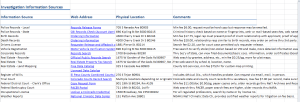
Here we have a compilation of online resources for basic investigation work. There is a wealth of information out there on the Internet but you need to know how to get at it and how far to trust it (and the answer for some online sources is “about as far as you can throw it and you can’t throw 1s and 0s”. Reference work was always my favorite and specialty when I worked in libraries and I have something of a knack for hunting down information so putting together this list was pretty enjoyable and I hope to make use of it in the future.

2012-12-16_0359

Supreme Court decides to enter the same-sex marriage conflict

The Supreme Court has chosen to weigh in on the same-sex marriage issue, announcing that it will hear both the appeal of California’s Proposition 8 (the case formerly known as Perry v. Schwarzenegger, now called Hollingsworth v. Perry since the state of California declined to attempt to defend the law in court any longer) and Windsor v. United States, a challenge to the clause of the federal Defense of Marriage Act that prohibits the federal government from recognizing any same-sex marriages, even those lawful in the state of celebration. The other major clause of DOMA, which holds that no state can be forced to recognize a same-sex marriage celebrated in another state, is not in the immediate scope of the Court. Most longtime observers do not expect that a ruling will touch the state recognition clause, which would be seen as a much more radical social change. A ruling against the federal recognition clause–already far from certain–would compel the federal government to recognize lawfully celebrated same-sex unions but would not extend gay marriage to any state where it is not currently legal.

It is likely that arguments in these two cases will rely heavily on the Due Process and Equal Protection clauses of the 14th Amendment and the justices’ analysis of whether sexual orientation is a suspect class like race and religion or a semi-suspect class like gender or neither. A law discriminating on the basis of a suspect class distinction must pass strict scrutiny, with a compelling government interest, with the narrowest scope and least restriction of liberty possible. A law with a semi-suspect class distinction must be substantively linked to a compelling government interest. If a class distinction is neither suspect nor semi-suspect, the law must only show a rational link to a government interest.  Legal scholarship is, of course, currently divided on how to deal with discrimination on the basis of sexual orientation. Windsor v. United States was given intermediate scrutiny by the 2nd Circuit Court of Appeals and found to be lacking. The Iowa Supreme Court applied strict scrutiny in Varnum v. Brien when it struck down that state’s marriage statute.

But to me the most interesting recent ruling–and one that has implications for the cases going before the Supreme Court–was Golinksi v. Office of Personnel Management. The federal district court of Northern California found that DOMA should be held to intermediate scrutiny…but that it failed to pass even the rational basis test. It found that the Republican-led Bipartisan Legal Advisory Group (defending DOMA since the Justice Department withdrew from the case) offered no reasons for the law’s existence that were rationally related to the putative government interests involved.

This is congruent with my own impression from reading amicus briefs submitted by traditional marriage groups. Since religious definitions of marriage are out of the question in a federal courtroom, the opponents of same-sex marriage base their case on the idea that marriage is fundamentally about procreation and childrearing, and couples who cannot impregnate one another without help from science are not suitable for marriage. This argument is difficult to sustain as proponents of same-sex marriage immediately reply, “But we let infertile straight people get married. We don’t annul marriages of straight couples who decide not to have children. And we don’t force couples to marry just because they have a child together. How is marriage only about babies?” As Bill Nye says, “Extraordinary claims require extraordinary proof”, and a claim that marriage as it exists in our society is not primarily about emotional pair-bonding is an extraordinary claim.

DOMA’s rational basis argument also is not helped by the CSPAN record of congresspeople debating it back in 1996, when there was scant mention of children as the sole purpose for the institution of marriage and much mention of homosexuality as a form of moral decay. The inconsistencies in the arguments offered in support of DOMA could make it much easier for the Supreme Court to find that the law lacks a coherent rational basis without even elevating sexual orientation to heightened scrutiny.