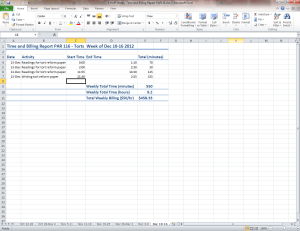
Every paralegal program class at PPCC has Time and Billing Reports as weekly assignments, one of the best practical career-prep elements of the program. In order to prepare for the necessity of tracking billable hours at a law firm, every week we record the tasks we do for each class, when the work occurred, how long it took, and what that time would cost at the current market rate for paralegal services. T&B reports are due every week at the same time, no matter how much or how little assigned work there was for the class that week. I found it to be very helpful in developing the skill of tracking my start and end times and noting when I switched from one task to another, since I am by nature something of a multitasker (my Internet browsers invariably have at least 3 tabs open at any one time). Below is a page from my Torts Time and Billing Report.
Category Archives: Basic Skills
Comparison of IRAC briefs, Part 2
As promised in my earlier post, here are two IRAC (Issue, Rule, Analysis, Conclusion) briefs from later in the semester. You can see how I’ve got a better sense of what needs citations and what does not, as well as gotten better at condensing the rule and the verdict down as far as possible without losing the essential information.
The first is from my Torts class, and presented a particular challenge as there were 5 separate issues being contested in the appeal.
Here is the feedback I received from Prof. Chase on my work:
The second is also a Torts brief. I feel this one represents my best work in distilling a lengthy opinion down into the shortest possible document that still covers all the relevant facts.
And the audio feedback for the Turner v. General Motors brief:
Comparison of IRAC briefs, Part 1
Case briefing was one of the most important skills taught this semester, comprising a major part of the grade and the instruction time in Introduction to Law, Family Law, and Torts. It sounds like it should be a snap–just pick out the most salient features of the case, arrange them in order, and then you’re done. Yes, it sounds very easy…right up until you’re eyeballs deep in a court opinion bristling with references to other cases trying not to get distracted from the thread of the argument and miss the one sentence in seven pages that contains the actual ruling. Still, once you’ve gotten over the initial learning curve with briefs, it gets easier to find those needles in the haystack.
The brief format used in all my classes was called IRAC, for Issues, Ruling, Analysis, and Conclusion. Ruling and Analysis are in the opposite order in the brief as in the court opinion, so they are often the hardest to lay out clearly.
What follows are two briefs I did very early on in the semester. In a second post, I’ll provide two more done at the end of the semester for comparison.
First, a brief from Introduction to Law:
And second, one from Torts:
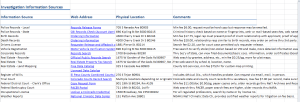
Resources for amateur gumshoes!
Here we have a compilation of online resources for basic investigation work. There is a wealth of information out there on the Internet but you need to know how to get at it and how far to trust it (and the answer for some online sources is “about as far as you can throw it and you can’t throw 1s and 0s”. Reference work was always my favorite and specialty when I worked in libraries and I have something of a knack for hunting down information so putting together this list was pretty enjoyable and I hope to make use of it in the future.
Legal research cheat sheet
A list of web resources for fast, thorough legal research I put together for Introduction to Law. It was more than a little disturbing to me as a former librarian and FOIA officer that the state of Colorado farms its public statutes out to LexisNexis rather than managing their own website. The heavy reliance on the three dominant legal research companies (Lexis, Westlaw, and Loislaw) also made me uneasy. Call me a hippie or a hacker but I do believe that some information is meant to be free-as-in-beer and free-as-in-speech.
Primary Sources
Citation Web Location
State statute (CCR, CRS, COR) Colorado Constitution, Court Rules, Revised Statutes
United States Code (USC) United States Code
Cornell University browsable USC
Government Printing Office prior year codes
United States Code – Annotated (USCA) Westlaw signin
Code of Federal Regulations (CFR) Annualized GPO edition
Local ordinance El Paso County ordinances
Secondary Sources
Citation Web Location
State digest Colorado Law Digest purchase page
Federal digest US Federal Law Digest purchase page
American Law Reports Lexis signin
Encyclopedia Wex, Legal Information Institute free encyclopedia
State LoisLaw Connect federal + one state ordering page
Corpus Juris Secundum Westlaw signin
Periodicals & treatises Hein Online signin
University of Colorado Law Review
More musings on legal ethics and information technology
Continuing on in the spirit of my post on “The Dream of the Paperless Office”, this is a research piece I did for Computers and the Law as a make-up for assignments that required software inaccessible to students with a used copy of the (exorbitantly expensive) textbook. While I understand that creating a textbook is a time-consuming process (I should know, one of my college courses created a free online textbook as a final project) and the creators deserve to be compensated for their effort, if prices become so steep that only a few students in the class can stretch their budget to accommodate a new copy of the course text, the publisher’s bottom line is still going to hurt. With free options like Coursera and Open University growing by leaps and bounds, publishers need to rethink their business models from the ground up or risk becoming obsolete.
Civil pleading and answer
This assignment was interesting in that it forced one to look at a case from both sides and think about the differing points of view and legal strategies involved. Torts are not my favorite area of law (administrative law is really more my cup of Scottish breakfast tea) but just as “democracy is the worst possible system of government…except for all the other ones” (hat-tip to Winston Churchill) the tort system of conflict resolution is the imperfect best case scenario for disputes that used to be settled by blood feud. Humans are going to step on one another’s toes and crash into one another’s cars as long as we endure as a species so it’s vital that we have a way to systematically deal with these transgressions.
The complaint:
And the reply:
Resume!
For all you potential employers out there, and for all you paralegals who might want to see what a good resume template looks like filled out, I present to you my own resume.
If any nibbles come of this post, professional and personal references and educational transcripts are also available upon request by email or snailmail.