
New semester and new job on the horizon!

As my first semester at PPCC draws to a close, I am taking stock of all I’ve learned but also looking forward to the new challenges January will bring. My courses for the new semester are Contracts, Property Law, Civil Litigation, and Estates and Probate. January is, of course, also the start of tax season (Feel free to ask me for tips! I AM authorized to practice taxes!) and thus a new phase of employment. This year I’ve been asked to be an office manager, so I am very much looking forward to whatever additional light my coursework can shed on the workings of tax law. Any knowledge I gain from it is knowledge I can also pass on to everyone else at my office, after all!

To all who read this, I wish you a happy holiday season and a bountiful new year!
Weekly Time and Billing Reports

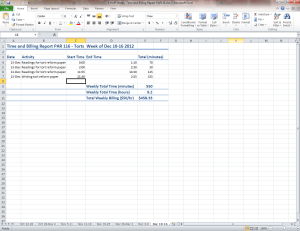
Every paralegal program class at PPCC has Time and Billing Reports as weekly assignments, one of the best practical career-prep elements of the program. In order to prepare for the necessity of tracking billable hours at a law firm, every week we record the tasks we do for each class, when the work occurred, how long it took, and what that time would cost at the current market rate for paralegal services. T&B reports are due every week at the same time, no matter how much or how little assigned work there was for the class that week. I found it to be very helpful in developing the skill of tracking my start and end times and noting when I switched from one task to another, since I am by nature something of a multitasker (my Internet browsers invariably have at least 3 tabs open at any one time). Below is a page from my Torts Time and Billing Report.

2012-12-16_0258

Comparison of IRAC briefs, Part 2

As promised in my earlier post, here are two IRAC (Issue, Rule, Analysis, Conclusion) briefs from later in the semester. You can see how I’ve got a better sense of what needs citations and what does not, as well as gotten better at condensing the rule and the verdict down as far as possible without losing the essential information.

The first is from my Torts class, and presented a particular challenge as there were 5 separate issues being contested in the appeal.

Here is the feedback I received from Prof. Chase on my work:

The second is also a Torts brief. I feel this one represents my best work in distilling a lengthy opinion down into the shortest possible document that still covers all the relevant facts.

And the audio feedback for the Turner v. General Motors brief:

Comparison of IRAC briefs, Part 1

Case briefing was one of the most important skills taught this semester, comprising a major part of the grade and the instruction time in Introduction to Law, Family Law, and Torts. It sounds like it should be a snap–just pick out the most salient features of the case, arrange them in order, and then you’re done. Yes, it sounds very easy…right up until you’re eyeballs deep in a court opinion bristling with references to other cases trying not to get distracted from the thread of the argument and miss the one sentence in seven pages that contains the actual ruling. Still, once you’ve gotten over the initial learning curve with briefs, it gets easier to find those needles in the haystack.

The brief format used in all my classes was called IRAC, for Issues, Ruling, Analysis, and Conclusion. Ruling and Analysis are in the opposite order in the brief as in the court opinion, so they are often the hardest to lay out clearly.

What follows are two briefs I did very early on in the semester. In a second post, I’ll provide two more done at the end of the semester for comparison.

First, a brief from Introduction to Law:

And second, one from Torts:

Comparison between two Last Will and Testaments

This example was the first assignment for my Computers and the Law course, meant to display the use of Microsoft Word more than familiarity with the provisions and format of estate documents. I utilized online examples to find the best legal terminology I could with my current skills.


The second example, from Introduction to the Law about 3 months later, comes in three parts. The assignment was to create a joint will and a living trust agreement, but my research revealed that joint wills are discouraged (though still technically legal) in Colorado. Instead, I executed a pair of mutual wills and prepared the requisite trust agreement. By this point I had gained a much better grasp of the necessary provisions of a proper will and was able to modify the standard language more extensively to suit my needs.

Comparison between 2 Memorandums of Law

This first example, a memorandum on paralegal ethics and Colorado rules regarding Unauthorized Practice of Law, was one of the first assignments I completed for Introduction to the Law, the ground-level course in the paralegal program. As you can see, while my general writing skills were fairly good I had not yet entirely mastered the preferred format and writing style.


The second example is from two months later, and it shows a better understanding of how to present a case brief in memorandum form and also more detailed legal reasoning.

Family Law assignment scenario

My Family Law course focuses pretty heavily on composing separation, custody, and divorce documents, so the professor handed out a sheet with a hypothetical couple, their children, their assets, and their tribulations and foibles. These formed the basis for several assignments that went from the initial filing and restraining order all the way through to the final divorce decree. I reproduce the scenario document here so that my future assignments based on it will be comprehensible.

And these were my first three documents produced from those assumptions:

The El Paso County Combined Courts have a, shall we say, quirk of using Wingdings characters for checkboxes on their downloadable forms, which makes them very difficult to fill out on the computer. I can’t imagine this encourages people to efile, but maybe they were concerned that creating real checkboxes in MS Word would make people with older versions of the software unable to open the documents.