
Weekly Time and Billing Reports

Every paralegal program class at PPCC has Time and Billing Reports as weekly assignments, one of the best practical career-prep elements of the program. In order to prepare for the necessity of tracking billable hours at a law firm, every week we record the tasks we do for each class, when the work occurred, how long it took, and what that time would cost at the current market rate for paralegal services. T&B reports are due every week at the same time, no matter how much or how little assigned work there was for the class that week. I found it to be very helpful in developing the skill of tracking my start and end times and noting when I switched from one task to another, since I am by nature something of a multitasker (my Internet browsers invariably have at least 3 tabs open at any one time). Below is a page from my Torts Time and Billing Report.
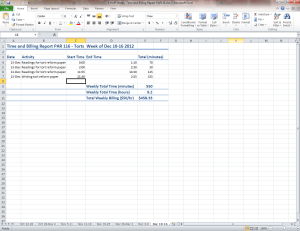
2012-12-16_0258

Durable power of attorney

An assignment from the unit on legal agency in Introduction to Law. I had dealt a few times before with general and specific powers of attorney in tax preparation situations, although in those cases I was checking the documents to verify that a military spouse was properly authorized to file on behalf of a deployed service member, instead of composing the documents to meet future needs. One of my instructor’s comments in the assignment feedback was that she found general powers of attorney quite scary, given what a poor agent could do with the power to sign contracts in the name of the principle!

Comparison between 2 Memorandums of Law

This first example, a memorandum on paralegal ethics and Colorado rules regarding Unauthorized Practice of Law, was one of the first assignments I completed for Introduction to the Law, the ground-level course in the paralegal program. As you can see, while my general writing skills were fairly good I had not yet entirely mastered the preferred format and writing style.


The second example is from two months later, and it shows a better understanding of how to present a case brief in memorandum form and also more detailed legal reasoning.

More musings on legal ethics and information technology

Continuing on in the spirit of my post on “The Dream of the Paperless Office”, this is a research piece I did for Computers and the Law as a make-up for assignments that required software inaccessible to students with a used copy of the (exorbitantly expensive) textbook. While I understand that creating a textbook is a time-consuming process (I should know, one of my college courses created a free online textbook as a final project) and the creators deserve to be compensated for their effort, if prices become so steep that only a few students in the class can stretch their budget to accommodate a new copy of the course text, the publisher’s bottom line is still going to hurt. With free options like Coursera and Open University growing by leaps and bounds, publishers need to rethink their business models from the ground up or risk becoming obsolete.

The Dream of the Paperless Office

With my background in information science (I worked in libraries for several years before shifting to focus more on administration and legal writing), this assignment for Introduction to Law was a blast from the past.

The dream of the paperless office has been around since at least the late 1970s and, like Chinese democracy, always seems to be ten years away. The rise of broadband modems, wireless internet, and affordable electronic storage may mean that soon we really will hit a record low in office paper consumption…although as an archivist and thus a professional musty paper enthusiast I seriously doubt that our society will ever go truly paperless. “Different technologies have different affordances”, as my iSchool professors used to say. The physicality and scribblability of paper are just better for a certain subset of tasks, just as the accessibility and duplicability of electronic documents are just better for others.

I’m still very glad my parents paid for those touch-typing lessons back in grade school, though.

Prenups can be fun!

Or at least they can be when the assignment scenario is as humorous and ripped-from-the-tabloids as this one.

Personally, I believe that prenuptial agreements get a bad rap. The most common complaints are that being so concerned with how the money gets split up is mercenary and unromantic, and that making contingency plans for if the marriage fails undermines the idea that you’re supposed to work to make sure your marriage is for life. My response to this has always been that someone whose love for their spouse is strong enough that they want to make sure even a divorce is as amicable and fair as possible is more romantic than flowery declarations that one’s love is blind to matters of money. Marriage has historically been and continues to be more advantageous for men than for women. We need to protect ourselves, ladies, even as we follow our hearts.