
Weekly Time and Billing Reports

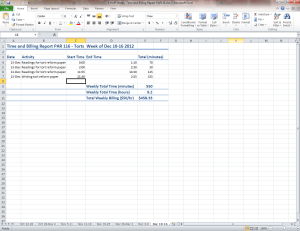
Every paralegal program class at PPCC has Time and Billing Reports as weekly assignments, one of the best practical career-prep elements of the program. In order to prepare for the necessity of tracking billable hours at a law firm, every week we record the tasks we do for each class, when the work occurred, how long it took, and what that time would cost at the current market rate for paralegal services. T&B reports are due every week at the same time, no matter how much or how little assigned work there was for the class that week. I found it to be very helpful in developing the skill of tracking my start and end times and noting when I switched from one task to another, since I am by nature something of a multitasker (my Internet browsers invariably have at least 3 tabs open at any one time). Below is a page from my Torts Time and Billing Report.
2012-12-16_0258

Articles of Incorporation

One of the last assignments during Introduction to the Law was to compose articles of incorporation for a for-profit entity. I was frankly stunned at how short such a document could be–stunned enough that when I found the instructions on the Colorado Secretary of State website I thought it must have been an error. But no! It was entirely correct.

The forms provided on that website, by the bye, are available only in non-fillable/non-copy-paste-able PDF format, forcing one to either print them out and fill in the blanks by hand or to transcribe the necessary language into a word processor.

And the Department of State is not the only governmental agency that seemingly encourages electronic filing but fails to format their digital documents properly. The Federal District Court for Colorado uses all .rtf or WordPerfect document types, despite the ubiquity of Microsoft Office and the availability of non-proprietary formats. The El Paso County Combined Courts have family law forms with checkboxes made not with macros but with Wingdings. It took me a good half an hour just to figure out what key combination in Wingdings produces something approximating a ticked checkbox.

Suddenly instruction in how to apply styles in MS Word seems a bit more important.

Resources for amateur gumshoes!

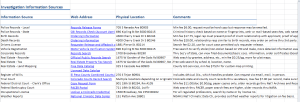
Here we have a compilation of online resources for basic investigation work. There is a wealth of information out there on the Internet but you need to know how to get at it and how far to trust it (and the answer for some online sources is “about as far as you can throw it and you can’t throw 1s and 0s”. Reference work was always my favorite and specialty when I worked in libraries and I have something of a knack for hunting down information so putting together this list was pretty enjoyable and I hope to make use of it in the future.

2012-12-16_0359

Legal research cheat sheet

A list of web resources for fast, thorough legal research I put together for Introduction to Law. It was more than a little disturbing to me as a former librarian and FOIA officer that the state of Colorado farms its public statutes out to LexisNexis rather than managing their own website. The heavy reliance on the three dominant legal research companies (Lexis, Westlaw, and Loislaw) also made me uneasy. Call me a hippie or a hacker but I do believe that some information is meant to be free-as-in-beer and free-as-in-speech.


Primary Sources

Citation                                                                             Web Location

State statute (CCR, CRS, COR)                           Colorado Constitution, Court Rules, Revised Statutes

Code of Colorado Regulations

Colorado Online Register

United States Code (USC)                                     United States Code

Beta of new website

Cornell University browsable USC

Government Printing Office prior year codes

PDF version

United States Code – Annotated (USCA)  Westlaw signin

Lexis signin

FindLaw free version

Code of Federal Regulations (CFR)               Annualized GPO edition

FindLaw edition

Cornell University edition

Local ordinance                                                         El Paso County ordinances

Colorado Springs city code

Secondary Sources

Citation                                                                             Web Location

State digest                                                                        Colorado Law Digest purchase page

Federal digest                                                                  US Federal Law Digest purchase page

American Law Reports                                             Lexis signin

Encyclopedia                                                                   Wex, Legal Information Institute free encyclopedia

Nolo free legal encyclopedia

State                                                                                        LoisLaw Connect federal + one state ordering page

Corpus Juris Secundum                                          Westlaw signin

Periodicals & treatises                                               Hein Online signin

Martindale Legal Library

FindLaw articles

University of Colorado Law Review

The Colorado Lawyer (Colorado Bar Association)

Law Week Colorado

Denver Journal of International Law and Policy

More musings on legal ethics and information technology

Continuing on in the spirit of my post on “The Dream of the Paperless Office”, this is a research piece I did for Computers and the Law as a make-up for assignments that required software inaccessible to students with a used copy of the (exorbitantly expensive) textbook. While I understand that creating a textbook is a time-consuming process (I should know, one of my college courses created a free online textbook as a final project) and the creators deserve to be compensated for their effort, if prices become so steep that only a few students in the class can stretch their budget to accommodate a new copy of the course text, the publisher’s bottom line is still going to hurt. With free options like Coursera and Open University growing by leaps and bounds, publishers need to rethink their business models from the ground up or risk becoming obsolete.

The Dream of the Paperless Office

With my background in information science (I worked in libraries for several years before shifting to focus more on administration and legal writing), this assignment for Introduction to Law was a blast from the past.

The dream of the paperless office has been around since at least the late 1970s and, like Chinese democracy, always seems to be ten years away. The rise of broadband modems, wireless internet, and affordable electronic storage may mean that soon we really will hit a record low in office paper consumption…although as an archivist and thus a professional musty paper enthusiast I seriously doubt that our society will ever go truly paperless. “Different technologies have different affordances”, as my iSchool professors used to say. The physicality and scribblability of paper are just better for a certain subset of tasks, just as the accessibility and duplicability of electronic documents are just better for others.

I’m still very glad my parents paid for those touch-typing lessons back in grade school, though.

Family Law assignment scenario

My Family Law course focuses pretty heavily on composing separation, custody, and divorce documents, so the professor handed out a sheet with a hypothetical couple, their children, their assets, and their tribulations and foibles. These formed the basis for several assignments that went from the initial filing and restraining order all the way through to the final divorce decree. I reproduce the scenario document here so that my future assignments based on it will be comprehensible.

And these were my first three documents produced from those assumptions:

The El Paso County Combined Courts have a, shall we say, quirk of using Wingdings characters for checkboxes on their downloadable forms, which makes them very difficult to fill out on the computer. I can’t imagine this encourages people to efile, but maybe they were concerned that creating real checkboxes in MS Word would make people with older versions of the software unable to open the documents.