
The final paper for my Torts course, summarizing the history of tort reform in Colorado and taking a position on what kinds of reform are most appropriate. I chose to focus on medical malpractice torts, as the rapid growth in health care costs as a percentage of GDP and the recent passage of the Patient Protection and Affordable Care Act (a.k.a. health care reform, a.k.a. Obamacare) made the topic particularly apropos.
Tag Archives: colorado law
Articles of Incorporation
One of the last assignments during Introduction to the Law was to compose articles of incorporation for a for-profit entity. I was frankly stunned at how short such a document could be–stunned enough that when I found the instructions on the Colorado Secretary of State website I thought it must have been an error. But no! It was entirely correct.
The forms provided on that website, by the bye, are available only in non-fillable/non-copy-paste-able PDF format, forcing one to either print them out and fill in the blanks by hand or to transcribe the necessary language into a word processor.
And the Department of State is not the only governmental agency that seemingly encourages electronic filing but fails to format their digital documents properly. The Federal District Court for Colorado uses all .rtf or WordPerfect document types, despite the ubiquity of Microsoft Office and the availability of non-proprietary formats. The El Paso County Combined Courts have family law forms with checkboxes made not with macros but with Wingdings. It took me a good half an hour just to figure out what key combination in Wingdings produces something approximating a ticked checkbox.
Suddenly instruction in how to apply styles in MS Word seems a bit more important.
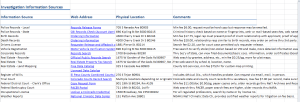
Resources for amateur gumshoes!
Here we have a compilation of online resources for basic investigation work. There is a wealth of information out there on the Internet but you need to know how to get at it and how far to trust it (and the answer for some online sources is “about as far as you can throw it and you can’t throw 1s and 0s”. Reference work was always my favorite and specialty when I worked in libraries and I have something of a knack for hunting down information so putting together this list was pretty enjoyable and I hope to make use of it in the future.
Comparison between two Last Will and Testaments
This example was the first assignment for my Computers and the Law course, meant to display the use of Microsoft Word more than familiarity with the provisions and format of estate documents. I utilized online examples to find the best legal terminology I could with my current skills.
The second example, from Introduction to the Law about 3 months later, comes in three parts. The assignment was to create a joint will and a living trust agreement, but my research revealed that joint wills are discouraged (though still technically legal) in Colorado. Instead, I executed a pair of mutual wills and prepared the requisite trust agreement. By this point I had gained a much better grasp of the necessary provisions of a proper will and was able to modify the standard language more extensively to suit my needs.
Comparison between 2 Memorandums of Law
This first example, a memorandum on paralegal ethics and Colorado rules regarding Unauthorized Practice of Law, was one of the first assignments I completed for Introduction to the Law, the ground-level course in the paralegal program. As you can see, while my general writing skills were fairly good I had not yet entirely mastered the preferred format and writing style.
The second example is from two months later, and it shows a better understanding of how to present a case brief in memorandum form and also more detailed legal reasoning.
Separation Agreement
Family Law’s toughest assignment by far was the separation agreement for the Jack and Jill Hill divorce case. The separation agreement is where the differences between the spouses really have to be confronted for the first time and the nitty gritty of breaking apart a shared household puts everyone’s nerves on edge. No wonder, then, that each section of the document has a “yes we do agree on this/no we’re still fighting about it” box to check. Divorces, like torts, are grueling but necessary processes. The anguish of divorce today is piddling compared to the long-term personal misery and resentment of the fault-based divorce days when the law forced you to lie in order to get closure. There’s a reason the government put an end to that and now allows people an escape when “the legitimate objects of marriage have been destroyed”.
Civil pleading and answer
This assignment was interesting in that it forced one to look at a case from both sides and think about the differing points of view and legal strategies involved. Torts are not my favorite area of law (administrative law is really more my cup of Scottish breakfast tea) but just as “democracy is the worst possible system of government…except for all the other ones” (hat-tip to Winston Churchill) the tort system of conflict resolution is the imperfect best case scenario for disputes that used to be settled by blood feud. Humans are going to step on one another’s toes and crash into one another’s cars as long as we endure as a species so it’s vital that we have a way to systematically deal with these transgressions.
The complaint:
And the reply:
Family Law assignment scenario
My Family Law course focuses pretty heavily on composing separation, custody, and divorce documents, so the professor handed out a sheet with a hypothetical couple, their children, their assets, and their tribulations and foibles. These formed the basis for several assignments that went from the initial filing and restraining order all the way through to the final divorce decree. I reproduce the scenario document here so that my future assignments based on it will be comprehensible.
And these were my first three documents produced from those assumptions:
The El Paso County Combined Courts have a, shall we say, quirk of using Wingdings characters for checkboxes on their downloadable forms, which makes them very difficult to fill out on the computer. I can’t imagine this encourages people to efile, but maybe they were concerned that creating real checkboxes in MS Word would make people with older versions of the software unable to open the documents.
 Legal (Para)Eagle: Kimberley Hoff's legal blog