
Comparison of IRAC briefs, Part 1

Case briefing was one of the most important skills taught this semester, comprising a major part of the grade and the instruction time in Introduction to Law, Family Law, and Torts. It sounds like it should be a snap–just pick out the most salient features of the case, arrange them in order, and then you’re done. Yes, it sounds very easy…right up until you’re eyeballs deep in a court opinion bristling with references to other cases trying not to get distracted from the thread of the argument and miss the one sentence in seven pages that contains the actual ruling. Still, once you’ve gotten over the initial learning curve with briefs, it gets easier to find those needles in the haystack.

The brief format used in all my classes was called IRAC, for Issues, Ruling, Analysis, and Conclusion. Ruling and Analysis are in the opposite order in the brief as in the court opinion, so they are often the hardest to lay out clearly.

What follows are two briefs I did very early on in the semester. In a second post, I’ll provide two more done at the end of the semester for comparison.

First, a brief from Introduction to Law:

And second, one from Torts:
Articles of Incorporation

One of the last assignments during Introduction to the Law was to compose articles of incorporation for a for-profit entity. I was frankly stunned at how short such a document could be–stunned enough that when I found the instructions on the Colorado Secretary of State website I thought it must have been an error. But no! It was entirely correct.

The forms provided on that website, by the bye, are available only in non-fillable/non-copy-paste-able PDF format, forcing one to either print them out and fill in the blanks by hand or to transcribe the necessary language into a word processor.

And the Department of State is not the only governmental agency that seemingly encourages electronic filing but fails to format their digital documents properly. The Federal District Court for Colorado uses all .rtf or WordPerfect document types, despite the ubiquity of Microsoft Office and the availability of non-proprietary formats. The El Paso County Combined Courts have family law forms with checkboxes made not with macros but with Wingdings. It took me a good half an hour just to figure out what key combination in Wingdings produces something approximating a ticked checkbox.

Suddenly instruction in how to apply styles in MS Word seems a bit more important.

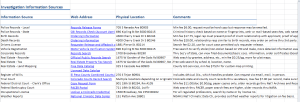
Resources for amateur gumshoes!

Here we have a compilation of online resources for basic investigation work. There is a wealth of information out there on the Internet but you need to know how to get at it and how far to trust it (and the answer for some online sources is “about as far as you can throw it and you can’t throw 1s and 0s”. Reference work was always my favorite and specialty when I worked in libraries and I have something of a knack for hunting down information so putting together this list was pretty enjoyable and I hope to make use of it in the future.

2012-12-16_0359

Durable power of attorney

An assignment from the unit on legal agency in Introduction to Law. I had dealt a few times before with general and specific powers of attorney in tax preparation situations, although in those cases I was checking the documents to verify that a military spouse was properly authorized to file on behalf of a deployed service member, instead of composing the documents to meet future needs. One of my instructor’s comments in the assignment feedback was that she found general powers of attorney quite scary, given what a poor agent could do with the power to sign contracts in the name of the principle!

Comparison between two Last Will and Testaments

This example was the first assignment for my Computers and the Law course, meant to display the use of Microsoft Word more than familiarity with the provisions and format of estate documents. I utilized online examples to find the best legal terminology I could with my current skills.


The second example, from Introduction to the Law about 3 months later, comes in three parts. The assignment was to create a joint will and a living trust agreement, but my research revealed that joint wills are discouraged (though still technically legal) in Colorado. Instead, I executed a pair of mutual wills and prepared the requisite trust agreement. By this point I had gained a much better grasp of the necessary provisions of a proper will and was able to modify the standard language more extensively to suit my needs.

Comparison between 2 Memorandums of Law

This first example, a memorandum on paralegal ethics and Colorado rules regarding Unauthorized Practice of Law, was one of the first assignments I completed for Introduction to the Law, the ground-level course in the paralegal program. As you can see, while my general writing skills were fairly good I had not yet entirely mastered the preferred format and writing style.


The second example is from two months later, and it shows a better understanding of how to present a case brief in memorandum form and also more detailed legal reasoning.

Legal research cheat sheet

A list of web resources for fast, thorough legal research I put together for Introduction to Law. It was more than a little disturbing to me as a former librarian and FOIA officer that the state of Colorado farms its public statutes out to LexisNexis rather than managing their own website. The heavy reliance on the three dominant legal research companies (Lexis, Westlaw, and Loislaw) also made me uneasy. Call me a hippie or a hacker but I do believe that some information is meant to be free-as-in-beer and free-as-in-speech.


Primary Sources

Citation                                                                             Web Location

State statute (CCR, CRS, COR)                           Colorado Constitution, Court Rules, Revised Statutes

Code of Colorado Regulations

Colorado Online Register

United States Code (USC)                                     United States Code

Beta of new website

Cornell University browsable USC

Government Printing Office prior year codes

PDF version

United States Code – Annotated (USCA)  Westlaw signin

Lexis signin

FindLaw free version

Code of Federal Regulations (CFR)               Annualized GPO edition

FindLaw edition

Cornell University edition

Local ordinance                                                         El Paso County ordinances

Colorado Springs city code

Secondary Sources

Citation                                                                             Web Location

State digest                                                                        Colorado Law Digest purchase page

Federal digest                                                                  US Federal Law Digest purchase page

American Law Reports                                             Lexis signin

Encyclopedia                                                                   Wex, Legal Information Institute free encyclopedia

Nolo free legal encyclopedia

State                                                                                        LoisLaw Connect federal + one state ordering page

Corpus Juris Secundum                                          Westlaw signin

Periodicals & treatises                                               Hein Online signin

Martindale Legal Library

FindLaw articles

University of Colorado Law Review

The Colorado Lawyer (Colorado Bar Association)

Law Week Colorado

Denver Journal of International Law and Policy

Civil pleading and answer

This assignment was interesting in that it forced one to look at a case from both sides and think about the differing points of view and legal strategies involved. Torts are not my favorite area of law (administrative law is really more my cup of Scottish breakfast tea) but just as “democracy is the worst possible system of government…except for all the other ones” (hat-tip to Winston Churchill) the tort system of conflict resolution is the imperfect best case scenario for disputes that used to be settled by blood feud. Humans are going to step on one another’s toes and crash into one another’s cars as long as we endure as a species so it’s vital that we have a way to systematically deal with these transgressions.

The complaint:

And the reply:

The Dream of the Paperless Office

With my background in information science (I worked in libraries for several years before shifting to focus more on administration and legal writing), this assignment for Introduction to Law was a blast from the past.

The dream of the paperless office has been around since at least the late 1970s and, like Chinese democracy, always seems to be ten years away. The rise of broadband modems, wireless internet, and affordable electronic storage may mean that soon we really will hit a record low in office paper consumption…although as an archivist and thus a professional musty paper enthusiast I seriously doubt that our society will ever go truly paperless. “Different technologies have different affordances”, as my iSchool professors used to say. The physicality and scribblability of paper are just better for a certain subset of tasks, just as the accessibility and duplicability of electronic documents are just better for others.

I’m still very glad my parents paid for those touch-typing lessons back in grade school, though.

Resume!

For all you potential employers out there, and for all you paralegals who might want to see what a good resume template looks like filled out, I present to you my own resume.

If any nibbles come of this post, professional and personal references and educational transcripts are also available upon request by email or snailmail.