
Weekly Time and Billing Reports

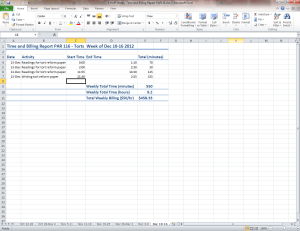
Every paralegal program class at PPCC has Time and Billing Reports as weekly assignments, one of the best practical career-prep elements of the program. In order to prepare for the necessity of tracking billable hours at a law firm, every week we record the tasks we do for each class, when the work occurred, how long it took, and what that time would cost at the current market rate for paralegal services. T&B reports are due every week at the same time, no matter how much or how little assigned work there was for the class that week. I found it to be very helpful in developing the skill of tracking my start and end times and noting when I switched from one task to another, since I am by nature something of a multitasker (my Internet browsers invariably have at least 3 tabs open at any one time). Below is a page from my Torts Time and Billing Report.
2012-12-16_0258

My 2 cents on tort reform

The final paper for my Torts course, summarizing the history of tort reform in Colorado and taking a position on what kinds of reform are most appropriate. I chose to focus on medical malpractice torts, as the rapid growth in health care costs as a percentage of GDP and the recent passage of the Patient Protection and Affordable Care Act (a.k.a. health care reform, a.k.a. Obamacare) made the topic particularly apropos.

Comparison of IRAC briefs, Part 2

As promised in my earlier post, here are two IRAC (Issue, Rule, Analysis, Conclusion) briefs from later in the semester. You can see how I’ve got a better sense of what needs citations and what does not, as well as gotten better at condensing the rule and the verdict down as far as possible without losing the essential information.

The first is from my Torts class, and presented a particular challenge as there were 5 separate issues being contested in the appeal.

Here is the feedback I received from Prof. Chase on my work:

The second is also a Torts brief. I feel this one represents my best work in distilling a lengthy opinion down into the shortest possible document that still covers all the relevant facts.

And the audio feedback for the Turner v. General Motors brief:

Comparison of IRAC briefs, Part 1

Case briefing was one of the most important skills taught this semester, comprising a major part of the grade and the instruction time in Introduction to Law, Family Law, and Torts. It sounds like it should be a snap–just pick out the most salient features of the case, arrange them in order, and then you’re done. Yes, it sounds very easy…right up until you’re eyeballs deep in a court opinion bristling with references to other cases trying not to get distracted from the thread of the argument and miss the one sentence in seven pages that contains the actual ruling. Still, once you’ve gotten over the initial learning curve with briefs, it gets easier to find those needles in the haystack.

The brief format used in all my classes was called IRAC, for Issues, Ruling, Analysis, and Conclusion. Ruling and Analysis are in the opposite order in the brief as in the court opinion, so they are often the hardest to lay out clearly.

What follows are two briefs I did very early on in the semester. In a second post, I’ll provide two more done at the end of the semester for comparison.

First, a brief from Introduction to Law:

And second, one from Torts:

Civil pleading and answer

This assignment was interesting in that it forced one to look at a case from both sides and think about the differing points of view and legal strategies involved. Torts are not my favorite area of law (administrative law is really more my cup of Scottish breakfast tea) but just as “democracy is the worst possible system of government…except for all the other ones” (hat-tip to Winston Churchill) the tort system of conflict resolution is the imperfect best case scenario for disputes that used to be settled by blood feud. Humans are going to step on one another’s toes and crash into one another’s cars as long as we endure as a species so it’s vital that we have a way to systematically deal with these transgressions.

The complaint:

And the reply: